Tag Archives: Ryan Grant

Ryan Grant usurps Papal Authority in an attempt to refute Br. Bugnolo

+ + +

Commentary and Refutation of Ryan Grant’s Position by Br. Alexis Bugnolo

French Translation

In the above article, published on October 27, 2025, Mr. Ryan Grant, attempts to show that this Bull no longer has any force of law, even in the particular of its censure of the election of a heretic as pope.

Before I comment on his treatise, I will cite my previous writings on this matter, which he does not so clearly present.

Back in May of this year of Our Lord, 2025, the first argument I moved against the validity of the election of Cardinal Prevost, was that the election of a man who is found to have deviated from the Catholic Faith before his election by the Cardinals was declared ipso facto invalid by the Bull of Pope Paul IV, Cum ex apostolatus officio.

In this, I cited my former argument on the matter, from 2015, and with the passing of some days, I returned to that argument and refined it, here — note that the edition of 2015 is revised, though the date still reflects the original publication:

This article discussed the effect of the promulgation of the Code of Canon Law of 1917, on the perpetual validity of the precepts contained in the Bull. And I concluded, that in regard to the declaration of the invalidity of an election of a Cardinal in a Conclave, who had previously deviated from the Catholic Faith, fell into heresy or adhered to a schism, that Papal censure on the validity remained valid.

Subsequently on August 19, I revisited the argument regarding, as I just mentioned, and published the revision separately here.

And on August, 2, of this year, I published the second English Translation of this Bull, publicly available, on the Internet — there may be others in books or manuals — Here:

+ + +

So far, for what I previously have written.

Ryan Grant’s Treatise — A Historic Publication

I think this particular tract by Ryan Grant is the most thorough and complete treatment I have ever seen him muster on any topic, and shows that he has come of age in the matter of public disputation.

As a dinosaur who has been doing such things since my first Refutation of Father Wathen, back in 1996 — if I remember correctly, I welcome the graduation of the newest tract-writer on the block.

Second, Ryan Grant’s essay is the first to cite me by name in any Catholic publication, since the L’Avvenire in the summer of 2021, so it is indeed quite extraordinary. OnePeterFive, where Ryan Grant’s essay is published, even extended to me the unheard of decency, of a hyperlink to my August article, cited above. That has not happened since the Team Bergoglio Scandal in December of 2014.

So for both reasons, I sense that someone has “broken reality itself” in the Trad inc. camp, where the absolute censorship of everything said or done by Br. Alexis Bugnolo has been the unbroken rule since Michael Matt’s last publication of a letter to the Editor of The Remnant back in like 2004 or something like that — my grey hairs being unable to recall that misty past, it being so long ago.

For each of these reasons, Ryan Grant’s article is historic and I recommend my readers, here at FromRome, to read it, if they have the time.

The Complete Refutation of Ryan Grant

Ryan Grant’s article is entitled, “The Bull Cum Ex Apostolatus Officio — Void and of No Authority.” — Leaders in publication are usually placed by the Editor, not the author, so I can scarcely fault Grant for this erroneous and scandalous title. But it needs to be said, that “of No Authority” is theologically and canonically erroneous and false, because, theologically speaking, it remains a monument of the authentic Papal magisterium, and canonically speaking, it remains a source for ecclesiastical jurisprudence. As such, these words are scandalous and ignorant, and should be removed or replaced.

Now, Grant’s article is lengthy, and would take several hours perhaps for the layman to read, if he was able and familiar enough with the terms, for when printed out, my browser produces a PDF file which is 27 pages long!!!!

So for Catholics who have not that time, I will cut to the meat of the problem with it: Ryan Grant has founded his argument on private interpretation.

You see, a Papal Law or Papal Bull can only be interpreted by the Roman Pontiff. There is no authentic interpretation, in the canonical sense, from any other source. Nor is there an honest interpretation of the same, in a juridical sense, if you interpolate words, and make the law say something it does not say.

Thus does Grant attempt to refute two of my positions.

My Refutation of Grant’s First Argument

In the First Position, Grant recites thus:

To summarize Bugnolo’s argument, while it is true that all penal sanctions of Cum ex are abrogated in paragraph 5 of Canon 6, the section of the Bull (n. 6) which deals with the election of the Roman Pontiff is not penal by nature, because it imposes no penalty, but only a discipline, per the language of the code, and thus under paragraph 6 of the same canon, it would have to be explicitly abrogated, otherwise it is still in force. This is easily refuted. St. Pius X had already abrogated this clause of Cum ex by his own constitution Vacante sede apostolica of December 25, 1904 (§29), where he abrogated all previous laws considering the voting in papal elections.

Unfortunately, since Grant has not ennumerated his paragraphs, I cannot give an exact location in his work for this quote, but it appears to be half-way through, according to the measure of the scroll bar in a browser.

Grant’s claim of the abrogation, does not cite the words of the Constitution of Saint Pius X. And as any good debater knows, that, when you cite a law in Latin but give not the citation in words, then your citation probably does not prove what you are claiming. This concern is deepened when the passage you cite, here §29 regards the burial of popes, not the election of heretics.

And that is the case, here, since, as you can see, here at the very words of Saint Pius X in the passage which Grant should have cited, n. 34, since as a Latinist he claims to be able to read Latin: I quote from the Latin edition at the Vatican Website, found here.

34. Nullus Cardinalium, cuiuslibet excommunicationis, suspensionis, interdicti aut alius ecclesiastici impedimenti praetextu vel causa a Summi Pontificis electione activa et passiva excludi ullo modo potest; quas quidem censuras ad effectum huiusmodi electionis tantum, illis alias in suo robore permansuris, suspendimus [27].

Where the footnote 27 reads:

[27] Clem. V, cap. 2, Ne Romani, § 4, de elect., I, 3 in Clem.; Pii IV Const. In eligendis, § 29; Greg. XV Const. Aeterni Patris, § 22.

Even if you cannot read Latin, you can see immediately that Grant has dishonestly referred to Vacantis Apostolicae Sedis of Saint Pius X, because in this passage, when it speaks of the suspension of previous laws (suspendimus), it cites the laws of Pope Clement V, Ne Romani, and Pius IV ‘s Constitution, In eligendis, and Pope Gregory XVI’s Constitution, Aeterni Patris. There is no mention of Cum ex apostolatus officio.

Here is my translation of n. 34, and its footnote:

34. None of the Cardinals, by pretext and/or cause of any excommunication, suspension, interdict or any ecclesiastical impediment you like, can in any manner be excluded from active and passive election as Supreme Pontiff: which censures indeed, only as regards the effect of this manner of election, We suspend, with the former (illis) otherwise remaining in their force. [27]

Here, the Latin “illis”, which according to the rules of Latin grammer are to be translated contextually as referring to the aforementioned matter, rather than they are normally rendered (“those”, “they”), and refers here to “excommunciation, suspension, interdict or any ecclesiastical impediment”.

Where the footnote 27 reads:

[27] Pope Clement V, in chapter of, Ne Romani, section § 4, de elect., I, 3 in Clem.; Pops Pius IV, in his Constitution, In eligendis, § 29; and Pope Gregory XV in his Constitution, Aeterni Patris, § 22.

Thus, since Saint Pius X explicitly restricts his suspension to these three Papal Laws, he obviously does NOT intend to suspend the effect of Pius IV’s, Cum ex apostolatus oficio.

This is also confirmed by a comparison of the text of n. 34 of Pope Saint Pius X’s Constitution, with n. 6 of Pope Paul IV’s constitution, because the latter speaks both of the right to vote and be voted for (electio activa et passiva), and of his censure when an election is to be or not to be considered valid; but the former speaks only of electio activa et passiva. These are two different things, as is obvious, since the latter, as I have said in my article in August, regards the right of the faithful to regard or not regard an election valid or not, whereas the former regards the right of a Cardinal to vote and be voted for. Those ignorant of Latin think that the right to be voted for, means the right to be elected, since they confound “being voted for” with “being elected”. The modern concept of “being elected” refers technically to “being voted for by the needed majority AND accepting the election”, but the Latin concepts of  electio activa et passiva, only refer to casting votes and receiving votes in one’s favor during the procedure of the Conclave.

However, Grant quotes for his position, Fr. Wernz-Vidal’s general statement, found in Wernz-Vidal, Jus Canonicum, t. 2, Rome, 1928. Tit. VIII, n. 413, p. 403. You can see Grant’s Footnote 21 for the Latin and his English translation of it. — This noted author, however, as has been seen from what I just said, obviously never read the footnotes which the Saintly Pope used in his Apostolic Constitution, since by placing footnotes to cite the previous laws which in regard to Papal Elections, which are to be suspended during elections of this kind, he has expressly restricted the limit of his own suspension. — Also, to say, “suspend” is not to say “abrogate”, since to suspend merely stays the application for a limited time. And since the determination of the validity of an election obviously takes place after the election, even this passage would not suspend anything at such a time, even if it referred to Cum Ex Apostolatus Officio.

Thus, I believe, Grant’s first argument against my position is entirely destroyed.

My Refutation of Grant’s Second Position

Grant’s second salvo against my argument follows immediately after his first. For he holds that my citation of Canon 2265 of the 1917 Code is inappropriate. And in this he advances his principal error, as he says:

… the 1917 code has a different scope. Moreover, it does not specifically address the situation with the Roman Pontiff, and the code is silent about how to proceed in that case, leaving us to turn to the dogmatic theologians …

For here he appeals to private authors to interpret papal law, which, as I said above, is a grave error and violates the very principal of ecclesiastical jurisprudence that only the authority issuing a law can interpret it.

Thus it is that he has usurped Papal Authority, perhaps without realizing it, since in a clear matter of omission, one cannot appeal to dogmatic theologians for anything.

And I cannot shout this out louder, since I have been shouting it since 2018:

THE CESSATION OF RIGHT IS NEVER PRESUMED.

Thus if the code of 1917 or 1983 clearly and explicitly does not alter the standing of a papal precept, we can never lawfully or morally presume that papal precept is no longer in force.

However, he makes his assertion of an erroneous principal of interpretation while conceding to me that the Code have not spoken of this matter, and thus concedes my argument, since, if the 1917 Code has not expressly established any other discipline, then, my argument, which holds that because it does not, the former remains in force, is completely validated, since as Christ declares, “Whatsoever you bind upon Earth shall be bound in Heaven …”, in Whose Royal Decree we find no clause such as, “and it shall not remain in force in the future, if some dogmatic theologian opines that it does not”.

Finally, I will omit a refutation of Grant’s false allegation, made in passing, later in his tract, that I hold that there is a footnote in canon 188, as I never made such a claim. I spoke of a footnote in a commentary on Canon Law.

Conclusion

Grant’s article was heavily criticized by “Chris Jackson” here, though ineptly since he does not know the first thing about jurisprudence or theological distinctions, not to mention following the erroneous approach of many sedevacantists, who falling into the same error as Grant, have recourse to erroneous arguments that the Bull remains valid because it contains infallible teaching, not distinguishing properly between a disciplinary and a dogmatic decree.**

I welcome Grant’s attempt to rebut this my present refutation. But I will not demand a response, since I do not want my brother in Christ to publicly shame himself by advancing any more unfounded arguments to make his point.

Thus, that the Bull of Pope Paul IV, Cum ex apostolatus offcio, in n. 6, in regard to the right of Catholics to hold the election of a Cardinal in a Conclave as invalid if he has previously (1) fallen into heresy, or (2) joined a Schism, or (3) deviated from the Catholic Faith, without repenting prior to his acceptance of his election, remains IN FORCE AND IN FULL EFFECT AND OF DIVINE AND PAPAL AUTHORITY, until a future pope, if he will or dare, explicitly refutes it, or in some other way effectively abolishes it.


FOOT NOTES

** Jackson publishes his critique of Grant on the Chinese based Substack platform, without mentioning my name of course, since Jackson’s handlers forbid him to do that, since all hell would break lose in his pysop if his readers came to know of my writings on the Conclave of 2025 or the Conclave of 2013. ( In the comments there, it appears there is a number of Zionist bots who claim that I am paid to say what I say, have never called for the abolition of Vatican II, and unfairly criticize “the annointed of Jakob”. But worse of all, I raise money to help the poor, suffering and canonically abused. That is unforgivable. — The only substantial criticism seems to confirm what AJ and I have said, that the C. J. operation is a MI6 operation, since they are incensed in that com thread that we together outted Lefebrve’s father as a MI6 agent, HERE) Jackson for his or her or its part lauds the Archbishop and finds nothing wrong with his father being an intel agent working for the United Kingdom. — As for “the annointed of Jakob”, he is living up to all the sterotypes by accusing Grant of “distracting Catholics”, when AOJ has hidden the invalidity of the conclave and the work of Catholics at Rome to have a Catholic pope, just the like of the other USAID narrative supporting “Catholic” mainstream and “independent” media. This is astronomical hypocrisy.

Answering questions from Ryan Grant

by Br. Alexis Bugnolo

I appreciate a good debate, because I want everyone to know the truth and that requires exposing falsehood and bad arguments. Many know this, and so often the Catholic faithful who accept the teaching of the Church write to me and ask what I think about arguments used by others to support the Apostasy which is ongoing in the Church.

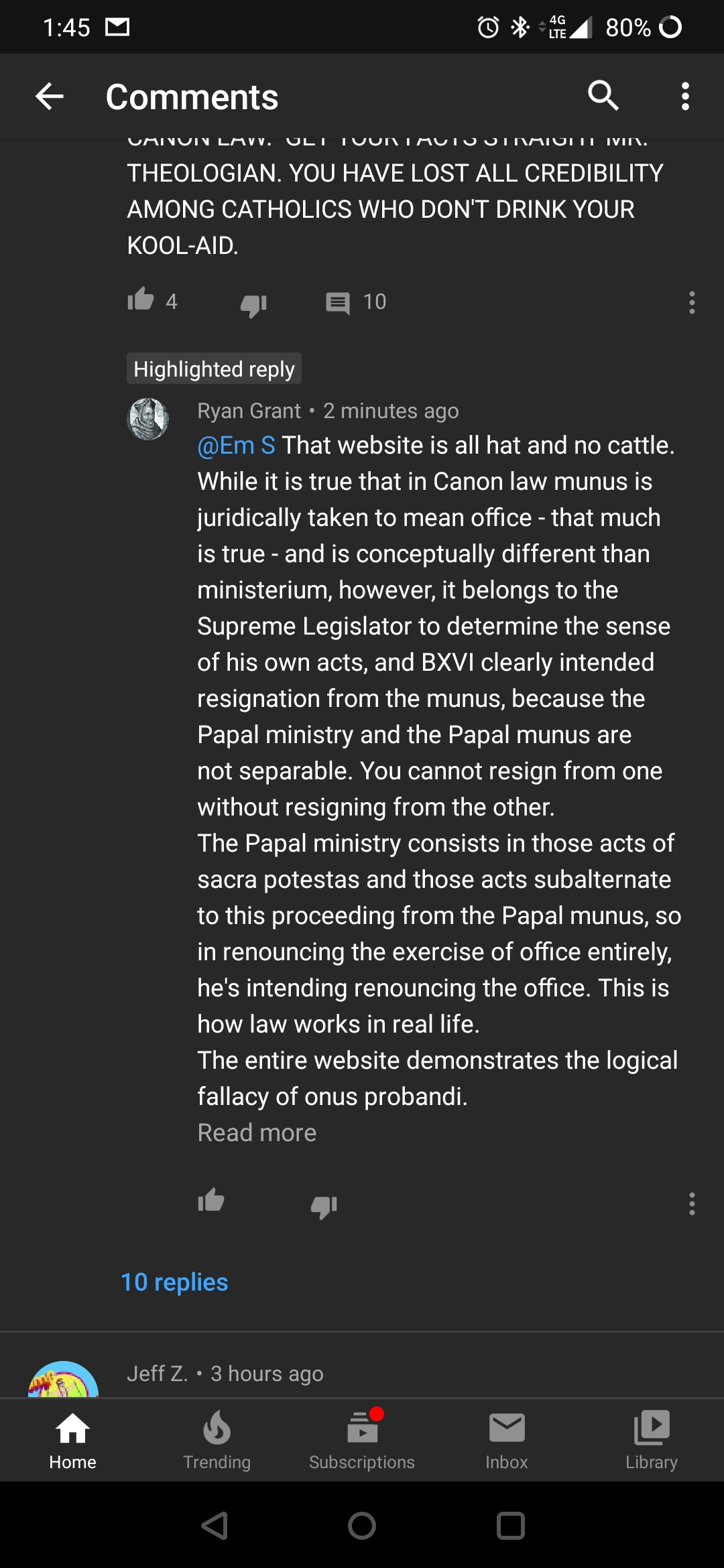
One such argumentor is Ryan Grant, and he bravely makes his argument on YouTube in the comment section of some video — where I do not know — but I have been sent screen shots of it, and will use them to make a further reply.

Ryan Grant is the translator of some of the writings of Saint Alphonsus. I do not think he has studied Canon Law, but then I do not know anything more about him.

So here we go… The context of his comments is the contents of PPBXVI.org the banner site for the Movement for Pope Benedict XVI, which does not have a comment section, . . ..
Screenshot_20200131-134548


Here is my reply, which I was solicited for by Grant’s interlocutor, who is a frequent commentator here at FromRome.Info:

While it is true that the Supreme Legislator is the Roman Pontiff and that he has the right and capacity to authoritatively interpret his own acts, Mons. Arrieta, Secretary to the Pontifical Council for Legal Texts, affirmed on Dec. 11, 2019, that the act of a papal renunciation is not subject to the interpretation of anyone, because it must be clear in and of itself, and no on has the right to interpret it, not even the one who makes it. And as Saint Alphonsus, who held a doctorate in both civil and canon law, says in his tract on Legal Interpretation, to interpret a word to mean that which it does not in normal parlance or legal tradition mean is an act of interpretation which can only be done by the legislator in a second and subsequent act. Therefore, though you are correct to say that the Roman Pontiff can normally interpret his acts, this is one act of which even an interpretation issued in forma specifica cannot correct via an interpretation. Indeed, as Mons Arrieta affirmed there never was a papal interpretation made of the act before Feb 29, 2013. So your objection is unfounded as to the matter and erroneous as to the form of your claim. This is how canon law really works, if you knew anything real about it.

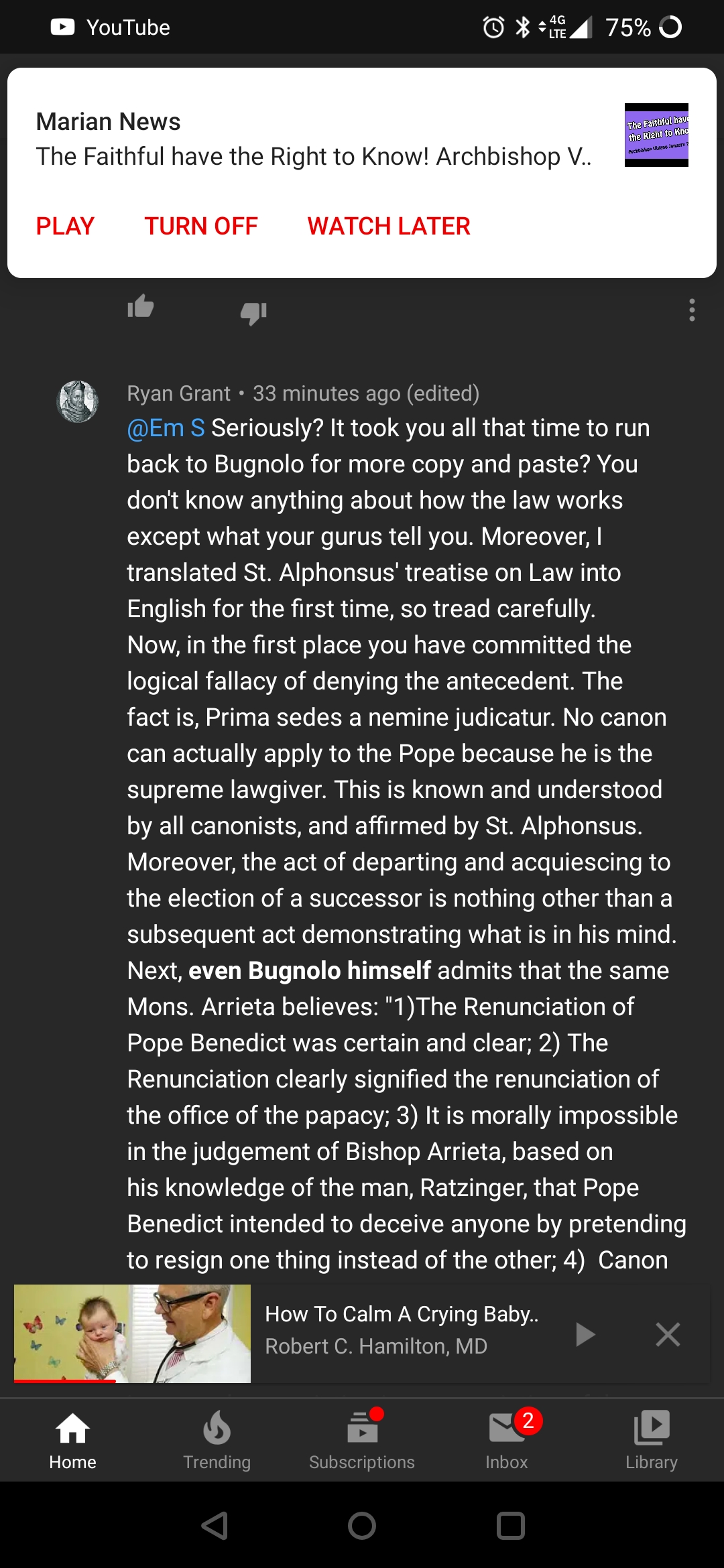
Grant rebuts my argument, thus:
Screenshot_20200131-195557

Grant makes the common fallacy of thinking that the one who resigns the papal office is the Pope. Nope! An act of papal resignation, as affirmed by Dr. Ghirlanda, S.J., professor of Canon Law here at Rome, in an article he published in March of 2013, affirms correctly that an act of renunciation of office is an act whereby one separates himself from the office he holds. — But the office cannot separate itself from itself.  — While it is true Canon 332 §2 speaks of that man as the Roman Pontiff, that is simply because prior to the act of renunciation the substance of the one acting bears that exalted dignity.

So Grant misapplies the principle, The First See is judged by no one, because he failed to notice that the one who resigns is not the See nor the Pontiff, but the man who holds the latter and occupies the former. Otherwise, if we are NOT talking about a papal resignation, then the principle applies to the Pope at all times. So Grant’s argument begins with a fallacy of fact and proceeds to a fallacy praeter rem. Thus it is invalid on two grounds.

Having been defeated on the point of legal interpretation, by my first reply, Grant, next, attempts to argue that the behavior of Pope Benedict XVI after Feb. 28, 2013 manifests his intention and his mind, and thus serves as an interpretation of the act. This is an argument which no canonist would ever make, since behavior is not a juridical act. But even common sense can see that since the Canon requires a Renunciation, and as all good Latinists know, a renutiare is an act which is verbal, not one made by gestures or actions, his argument is also praeter rem, and presupposes a fallacy of not reading the Canon in its precise terms. For the canon says, “If a Roman Pontiff renounce,” not, “If a Roman Pontiff separate himself from his office.”

His next argument is drawn from my published notes on my meeting with Bishop Arrieta. You can read my notes for yourself here. — This means that Grant does read FromRome.Info, even if he is ashamed to admit it. — Well, then, Grant is confused. Because you cannot admit principles and then try to undermine them by personal testimony. Bishop Arrieta and I agreed on many principles, and in my notes I pointed out that my questions regarding where we disagreed were never answered. So Grant is saying that since Bishop Arrieta does not agree with me but refused to give me a reason for his disagreement, which is in accord with any principle of law, that that means that I am wrong and Arrieta is correct. I do not think sane people argue this way, but that is not a valid argument, because it cites no reason.

Screenshot_20200131-195609

Next, Grant admits that no one can interpret the Act of renunciation, and then argues that since Barnhardt and I say it means what it says, but Arrieta says it means something else, that clearly Barnhardt and I are wrong. This is the same kind of mental argumentation I see often by those who say Benedict is not the pope. It is called gaslighting, because Grant is insisting on something contrary to the basic laws of language, namely when you explain anything using different words you are interpreting the statement which you are explaining. Ann and I do not do that. Grant and Arrieta do. So they are condemned by the very principles they admit, even if they insist that others view reality in their own distorted manner. This is so like the Left!

Finally, Grant gets into big ontological problems with his assertion that ministry and power flow from the munus and thus to renounce them is to renounce the munus. I guess he cannot understand my Scholastic Question, which was all about the distinction found in all the Scholastics like Saint Thomas Aquinas, that the substance holds all the potentia of the being of a thing, and thus to renounce anything which flows from the substance is not and cannot be a renunciation of the substance, just like when you renounce staying awake and thus fall asleep, you still have the power and being to wake again in the morning. Once again, then, Grant argues against reality itself. What can I say? I do not have to refute him, reality itself does that more eloquently.

As for his assertion that canonists all agree with him, that is gratuitous. I do not know of any canonist in the entire Church who has marshaled an argument for Grant’s position. Not even Bishop Arrieta. All you get in reply is assertions without arguments. And in logic, that means you have conceded that your position is irrational, and thus untrue, unless of course you are an idiot who cannot think or reason, which none of these men are.

There is another error in Grant’s argument, and Mons. Arrieta made the same error: they both hold that the Canon says, “If a Roman Pontiff renounce his office.” But that is not what it says; it says, “If a Roman Pontiff renounce his munus.” Canon 1331 in section 2, n. 4, shows that the Code of Canon Law distinguishes between munus and office. That means that the specific act essential to a papal renunciation does require the renunciation of munus, and that means, that both the liberty and due manifestation required, also regard the renunciation of the munus. This is a very important point, and is the key argument to use against all of Pope Benedict’s opponents. They have to use this fallacious reading, because they can see that the text of the Declaratio is not in conformity with the Canon.

Now I understand why Grant does not want to argue with me directly. I have challenged everyone to a debate, even 3 Pontifical Faculties of Canon Law, no one takes my offer, because they do not want to expose that their position is irrational and not sustained by the principles of law. — However, I grant this to Ryan, he has had the integrity to argue it in public. I respect him for that.

POSTSCRIPT: I have be subsequently informed that these comments by Mr. Grant are found in the comment section of this video.

____________

CREDITS:  The Featured Image is a photo taken by Br. Bugnolo of one of the bas relief in the Basilica of Saint John, here at Rome. The screen shots of Grant’s comments taken from a public forum on Youtube are in the public domain and used according to fair use practice for editorial commentary.

+ + +

[simple-payment id=”5295″]